


This week’s video transcript summary is here. You can click on any bulleted section to see the actual transcript. Thanks to Granola for its software.
Editorial
Blowing the Balloon
SpaceX is now a public company worth over $2 trillion. Most commentators are grimacing at the valuation and the personal net worth of Elon Musk (the first trillionaire in the world).
Brad Gerstner on X showed a reason not to think like that. A picture tells a thousand words, or in this case a trillion:


What is Brad saying out loud here? Good investors price the future value of the asset they are investing in, not its current value. SpaceX is worth over $2 trillion today because it is believed it will be worth many times that in future. None of the early investors are selling shares today. Indeed, they can’t because of various lockup provisions. But even when unlocked, they will be likely buyers, not sellers.
This coincides with an excellent piece by David George from Andreessen Horowitz that attempts to characterize what kind of a founder a late stage company requires.
“Growth-stage venture” has emerged as its own asset class, and we think it’s the most important asset class in the world. But we also think that most people misunderstand what it’s about. It’s not just a structural change in fundraising, or about valuations, or staying private. Late-stage venture is about late-stage founders. It’s about a specific kind of person, who can keep deploying dollars attractively, indefinitely.
Deploying dollars attractively, indefinitely means investing in growth.
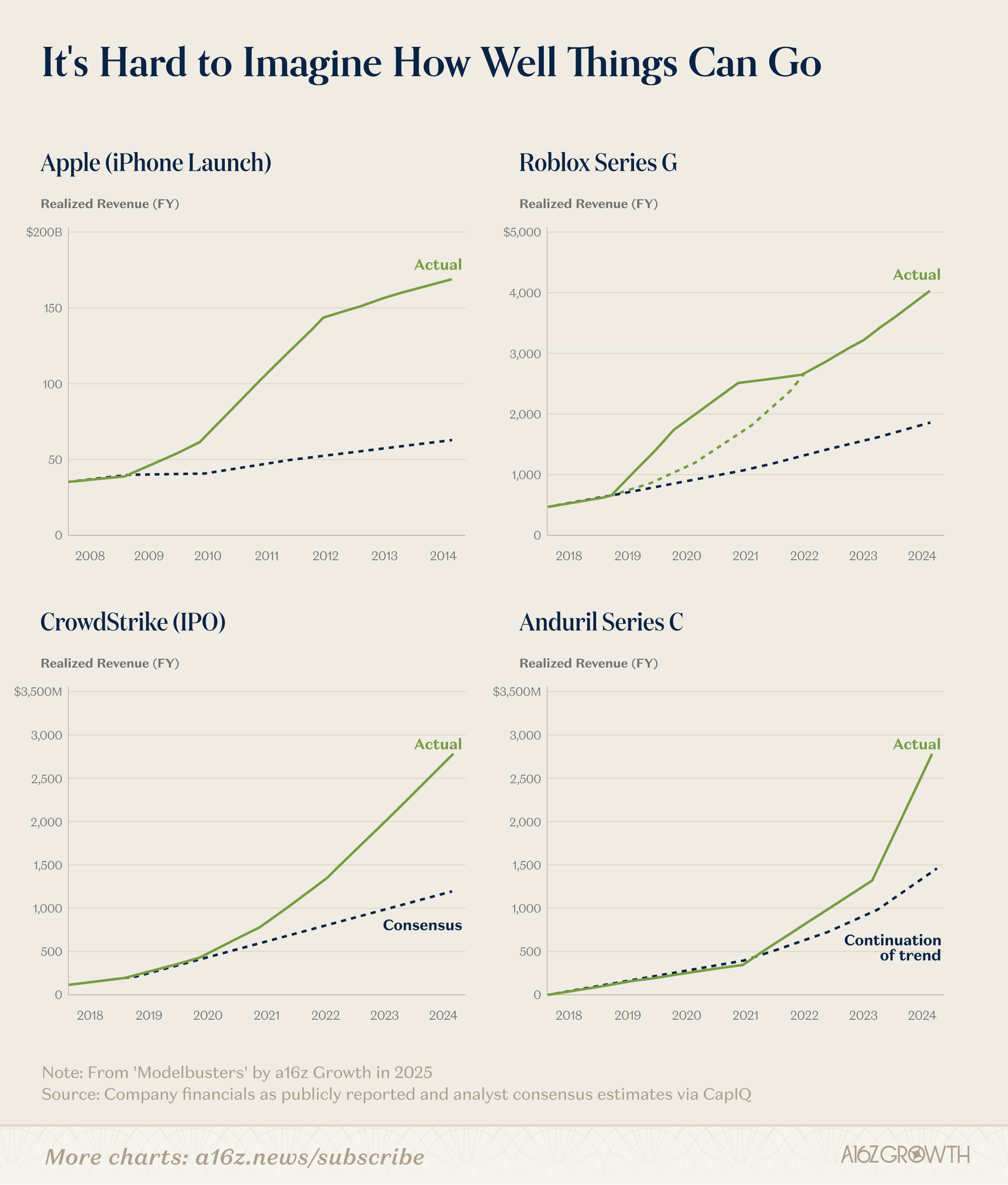
Founders are not afraid of pressure to perform; not if they’ve made it this far. What founders don’t like is the pressure to do the consensus thing, rather than make the bets that would result in that continued 100% growth, that pervades analyst calls and shareholder feedback. It goes against their instincts about how to make good decisions, and about where the alpha in the company comes from. And each generation of founders learns from the previous one; that’s why they’re staying private longer.
And that really is the story of issue #21 of That Was The Week for 2026.
SpaceX is early in its life at 25 years old. Anthropic and OpenAI, both of which filed confidentially for IPOs in the past few days, are similar, but even younger. Both will be worth a lot of money in future, and $1 or 2 trillion today will look small in future.
The spending on data centers, on earth and in space, is the current version of Jeff Bezos running a loss at Amazon for decades. It is not making a loss, it is making an investment.
Excuse the analogy but ….
When your breath blows up a balloon, you are not losing breath. You are investing breath in the growth of the balloon.
So long as it keeps expanding, you keep blowing.
If you are insecure about it bursting you will stop blowing, and you will have a smaller balloon than the blower personality.
Dario Amodei’s essay - Policy on the AI Exponential - clearly places him as not a balloon blower. Whereas Sam Altman at least attempts to play the role of a balloon blower (but ultimately fails) in Built to benefit everyone: our plan.
Breaking News
The Government has forced the suspension of Anthropic’s Fable/Mythos v5 models. Anthropic is complaining, despite Dario’s essay this week begging for regulation and prevention.
Musk, on the other hand, keeps on blowing up the balloon. And rising…
For these reasons today is not a day to chastise Elon Musk for being the richest person ever. It is a day to celebrate risk, and the wealth it creates. Not the personal wealth but the societal wealth. And also the indomitable personality traits that make it possible. It is not disgusting, it is testimony to what is possible.
Growth Needs a Plan
Then there is Europe, and also California. They have something in common. Neither likes unbounded wealth. Both seek to curtail, slow down, and seize some or much of it. Francis Fukuyama’s essay on Liberal Values, and many of this week’s essays are written from the point of view of states, political systems, and governance.
The Interview of the Week between Andrew Keen and Jonathan Weber - ‘Save San Francisco’s Soul’ discusses his book ‘The City on the Edge’ and is also part of this discourse on the future.
Strangely the SpaceX IPO and those that will follow contain answers to some of the questions we are all asking. The main one is about life, and the experience of life we should all expect from the future.
Poor governance - and Europe and San Francisco have an abundance of it - is a symptom of poor vision. Last week we spoke about the lack of an ‘End Game’ in most discussions of the future.
San Francisco should benefit from multi-trillion IPOs. Housing, education, health, leisure should all be boosted by the production of value. The same holds true for Europe, and by proxy, really everywhere. But that requires a plan for embracing growth, and then mechanizing how it supports a healthy civilization. The reaction to Musk indicates how hard it is for many to embrace growth and the wealth it throws off.
Complaining (whining) has never been an attractive character trait. It is even worse when unaccompanied by any plan to change things.
Apple understood part of this at WWDC better than many commentators did. I do not think Apple won AI in the frontier-model sense, and I do not think that matters very much. What matters is that Apple is building useful things for the future.
If Google has more raw capability and OpenAI has more narrative momentum, Apple may still own the daily interface if it can make AI feel calm, local, useful, and subordinate to the user. That is capacity too. It is not benchmark capacity. It is adoption capacity. And it is using capability to deliver real benefits. Governance could learn a lot from Apple’s product and go-to-market teams.
On the more thoughtful side, Paul Krugman is right that powerful technologies do not automatically translate into productivity booms, wage growth, or social progress. History is full of lags, bottlenecks, and wrong analogies. Sangeet Paul Choudary is right to warn that efficiency gains can shift bargaining power away from workers if platforms capture the customer relationship and the system of record. Freddie deBoer is right that “go into the trades” is not a serious labor-market answer unless we say which trades, under which institutions, with which rights and protections. Rebecca Haw Allensworth’s licensing argument adds the companion point: skills do not matter much if insiders can make entry expensive, slow, and exclusionary.
So yes, the skeptics have a serious case. AI could produce more concentration, more surveillance, and more labor insecurity long before it produces abundance. And if complaining is the bulk of the response, bad things may happen.
Planning Beats Complaint
This is not only a city, continent or technology story. It is becoming a civilization story.
Europe 2031 makes the point that values without compute, energy, talent, data centers, adoption, and political speed become rhetoric. Not to mention investment.
Francis Fukuyama argues that Europe cannot defend liberal values by retreating into ethnic or religious nostalgia. That is the wrong point. Europe needs to take control of investing in a plan for the future.
The same with John O’Farrell. He brings the same problem home to American AI politics. If venture money is used to pre-empt democratic debate before lawmakers understand the technology, then “innovation freedom” starts to look less like openness and more like regulatory capture. Technology cannot wait for politicians to catch up. That would be at the expense of society. But politcians do have to catch up.
Complaint is a negative. Whining is its form. Planing is empowering and acting on the plan is the form. That is why Elon Musk symbolizes what is required. He is necessary, but not sufficient. Next up? Planning how society benefits.
Contents
Editorial
Essays
AI
Alex Imas and Phil Trammell - What remains scarce after AGI?
Systems of Record Won the SaaS Era - Clearinghouses Will Win the Agents Era
Chasing the Hallucinations: KPMG’s AI-Powered Attempt at “Redefining Excellence”
Jeff Bezos’s Prometheus raises $12B to build an ‘artificial general engineer’ for the physical world
Venture
Regulation
Infrastructure
Interview of the Week
Startup of the Week
Post of the Week
Essays
A Liberal Vision For Europe
Author: Francis Fukuyama Published: June 9, 2026

Francis Fukuyama argues that Europe should not define itself through an ethnic or actively Christian account of “Western Civilization,” even though Christianity is part of its inheritance. His case is that the usable European identity is the Enlightenment one: universal rights, constitutional government, openness, tolerance, empirical inquiry, and rule of law.
The AI turn gives the essay its place in this issue. Fukuyama says Europe faces a dual technological challenge: it lacks frontier-scale AI companies, and AI is being developed largely by private technocratic actors whose incentives are profit and power, not a democratic conception of the common good. Starlink becomes his warning example: critical infrastructure controlled by a private actor can become foreign policy outside normal public accountability.
The pull is that Fukuyama is not asking Europe to retreat into nostalgia. He is arguing that agency over the future depends on defending the liberal institutions that make collective self-government possible, precisely as AI and platform power make private control of public life more plausible.
Read more: Persuasion
Europe 2031
Author: Daan Juijn, Stan van Baarsen, Judith Dada, Lily Stelling, Philip Fox, Alex Petropoulos, and Michiel Bakker Published: June 11, 2026

Europe 2031 is a scenario essay about what happens if Europe keeps treating AI as a regulatory and values problem while the United States and China treat it as the next industrial base. It is not written as prediction. It is written as a disciplined warning: Europe misreads DeepSeek as proof that compute does not matter, lets the bubble narrative slow urgency, bans many officials from using frontier systems, and then discovers that access to advanced AI has become a geopolitical favor rather than a right.
The killer detail is the compute gap. The authors argue that Europe controls roughly five percent of global AI compute against America’s eighty percent, leaving it with little leverage when frontier models, cybersecurity, robotics, and industrial production become strategic infrastructure. Their recommendations are correspondingly blunt: build tens of gigawatts of compute on European soil, partner with American providers while securing jurisdiction and access, form a coalition of AI middle powers, reform labor markets for AI adoption, and use Europe’s industrial strengths in robotics and manufacturing rather than pretending it can simply recreate the full LLM stack.
The pull is that this sits directly beside Fukuyama’s liberal Europe argument. Fukuyama says Europe must defend liberal self-government against private platform power. Europe 2031 says that self-government becomes rhetorical if Europe lacks the compute, talent, energy, industrial data, and political courage to act at AI speed.
Read more: Europe 2031
We Can’t Let My Former V.C. Colleagues Buy Off Our Democracy
Author: John O’Farrell Published: June 11, 2026

John O’Farrell, a former general partner at Andreessen Horowitz, argues that Silicon Valley is betraying its own open-competition mythology by using AI wealth to pre-empt democratic control of AI policy. His target is not AI optimism itself. It is the political machinery around it: pro-AI groups, backed by some of the industry’s most powerful players, raising large sums to defeat candidates who favor stricter AI regulation and support candidates expected to stay out of the industry’s way.
The killer detail is the timing. O’Farrell says AI should be forcing a national debate among unions, child-safety advocates, civil-rights groups, economists, companies, and legislators about jobs, biology, education, truth, and concentrated power. Instead, the money is arriving before political understanding has caught up. That makes the campaign important evidence in the open-AI-development fight: whether the public argument is really about innovation freedom, or about preventing independent lawmakers from setting rules for an industry that already knows how much power is at stake.
The pull is that the essay comes from inside the venture world. A former a16z partner is saying the old Silicon Valley story - technology dismantles power, upstarts win on the merits, open debate matters - is being inverted just as AI becomes the central political technology of the decade.
Read more: The New York Times
AI and the Pitfalls of Innovation
Author: Paul Krugman Published: June 7, 2026
Paul Krugman starts a series on AI economics by resisting the cleanest available analogy. Electrification is useful because it reminds us that general-purpose technologies can take decades to show up fully in productivity statistics. But Krugman argues that it is not the only history worth carrying into the AI debate. The postwar productivity boom and the early fade of the IT boom are equally important warnings against assuming that one spectacular technology automatically rewrites wages, employment, and output on schedule.
The useful move is methodological. Krugman is not saying AI is a fad. He is saying the economics are underdetermined: data centers may be a short-term bubble, productivity gains may arrive unevenly, and the labor-market consequences may depend more on institutions and distribution than on model capability alone. That fits this issue’s theme because the AI story is moving from “can the technology work?” to “who captures the surplus, and how fast does it become visible?”
Read more: Paul Krugman
The Jevons Misunderstanding
Author: Sangeet Paul Choudary Published: June 7, 2026
Sangeet Paul Choudary takes aim at the comforting version of Jevons Paradox now circulating in AI debates. The simple claim says cheaper work creates more demand, so workers will be fine. Choudary’s point is sharper: demand expansion only helps workers if the production system still needs them in a position to claim the new surplus.
The killer distinction is augmentation versus complementarity. AI may help a worker do a task and still reduce that worker’s bargaining power if the tool captures the workflow, separates the worker from the customer, and turns expertise into training material. In that world, the market can grow while labor’s share shrinks.
The pull is that Jevons is not a labor policy. It explains why consumption may rise when efficiency improves. It does not explain who owns the resulting market, whether workers sit above or below the algorithm, or whether AI expands the old labor bundle or routes around it.
Read more: Platforms, AI, and the Economics of BigTech
There’s No Such Thing as “The Trades”
Author: Freddie deBoer Published: June 8, 2026
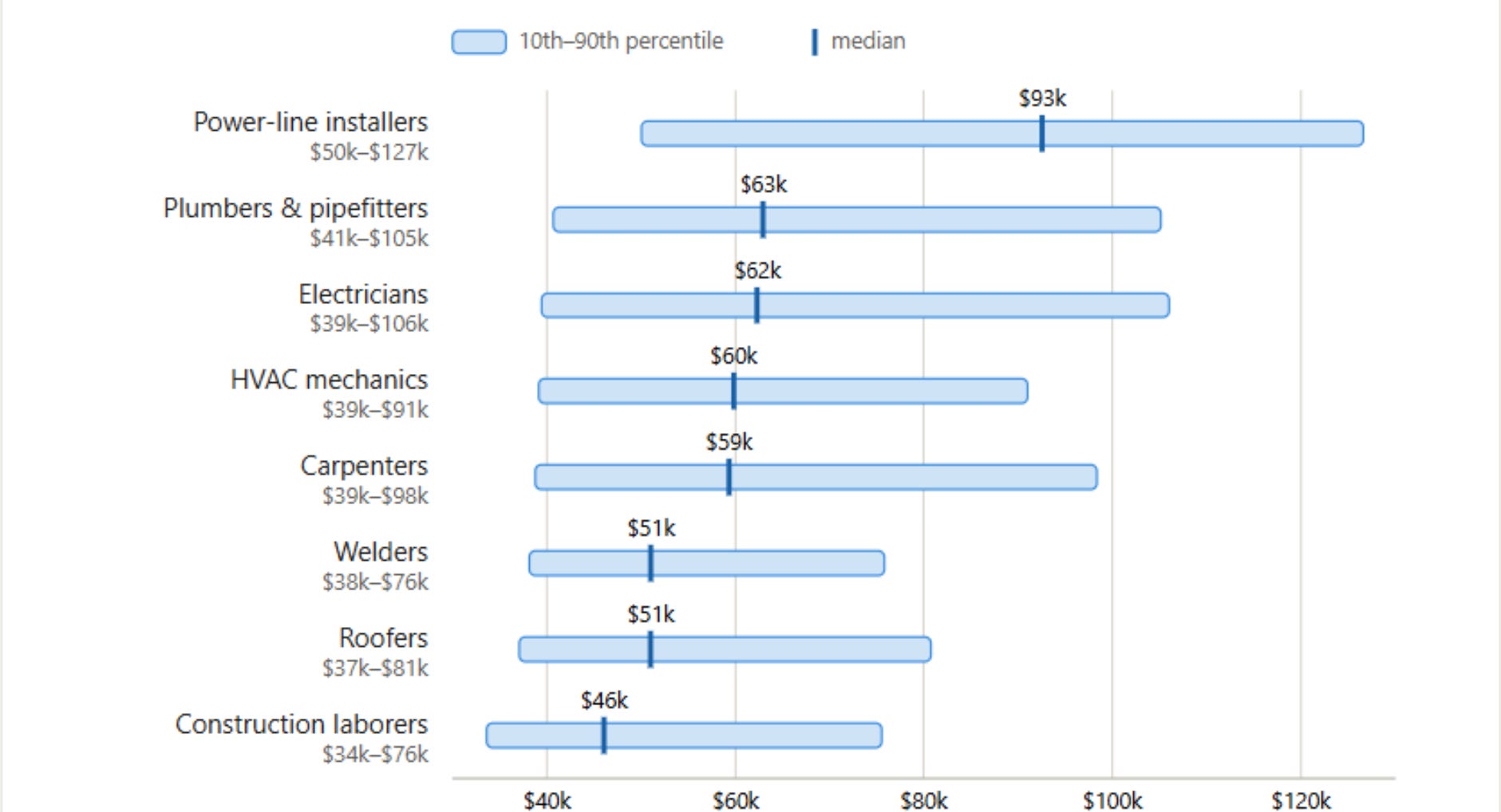
Freddie deBoer argues that “go into the trades” has become the new “learn to code”: a comforting labor-market slogan that turns a complicated set of occupations into a single imaginary safe bet. He supports broader non-college pathways, but says the advice becomes useless when it treats plumbing, electrical work, carpentry, welding, HVAC repair, and other jobs as one category with one economic future.
The killer detail is the variance inside the label. An elevator mechanic, residential drywaller, journeyman lineman, diesel technician, flooring installer, and stationary engineer can all be described as working in “the trades,” yet their pay, union protection, apprenticeship structure, physical toll, job security, and long-term prospects differ sharply. Some paths lead to pensions and durable bargaining power; others look more like gig-style subcontracting with bodily risk attached.
The pull is precision: if the goal is to give young workers better routes to prosperity, the useful question is not whether they should enter “the trades,” but which specific occupation, under which labor conditions, and with what realistic future.
Read more: Freddie deBoer
Rebecca Haw Allensworth on How Professional Licenses are Rigging the Game for Insiders
Author: Yascha Mounk with Rebecca Haw Allensworth Published: June 9, 2026
Embed: YouTube
Yascha Mounk’s conversation with Vanderbilt law professor Rebecca Haw Allensworth belongs beside this week’s labor-market essays because it turns “skills” into a power question. Allensworth argues that professional licensing has become one of America’s most important regulatory institutions, covering roughly one in five workers and often functioning less like consumer protection than a modern guild system.
The killer detail is the barber example. In some states, learning to cut hair can require a year of school, large tuition bills, and unpaid time away from work, even when the underlying safety risk is modest. The same logic appears in medical licensing, therapy supervision, alarm installation, and immigrant credential recognition: incumbents write rules that look neutral but narrow entry, limit mobility, and protect rents.
The pull is that “the trades” debate needs this companion piece. Telling people to choose non-college work is incomplete if licensing boards can still make work artificially scarce, expensive to enter, and hard to move across state lines.
Read/watch: Yascha Mounk
Trump’s war on state capacity is coming home to roost
Author: Matthew Yglesias Published: June 10, 2026
Matthew Yglesias uses the return of the New World screwworm, measles pressure, and Ebola risk to make a broader argument about state capacity. The point is not that every outbreak or institutional failure can be pinned on one administration. It is that public health, agricultural containment, surveillance, and international coordination are systems that work only when the state keeps boring competence alive between crises.
The killer detail is the sterile screwworm program. Rachel Carson described it as an eco-modernist alternative to spraying insecticides everywhere: breed male screwworms, sterilize them with radiation, and release them so the next generation collapses. The program eventually pushed the pest out of the United States, Mexico, and Central America, but the barrier began wobbling after pandemic disruption, surveillance gaps, and cross-border disorder.
The pull is governance: AI, health, immigration, energy, and defense all depend on institutional muscle that is easy to mock until it fails. The week’s larger theme is not only whether technology is moving fast, but whether public institutions still know how to maintain the systems that make speed survivable.
Read more: Slow Boring
How California became a case study in failed governance
Author: Fareed Zakaria Published: June 12, 2026
Fareed Zakaria argues that California’s central contradiction is no longer ideological but operational: one of the world’s most dynamic economies is attached to a government model that spends more while producing too little of what ordinary residents need. The essay ranges across housing, education, homelessness, domestic outmigration, job creation, and the erosion of Los Angeles’s entertainment production base.
The killer detail is the California paradox. The state has Silicon Valley, Hollywood, universities, ports, agriculture, talent, capital, and climate, yet many middle-class residents experience it as expensive, slow, exclusionary, and hard to build in. Zakaria’s point is not that California lacks wealth or creativity. It is that institutional performance has not kept pace with the society the economy created.
The pull is that this belongs next to Andrew Keen’s San Francisco interview. Jonathan Weber turns San Francisco into the city-level case study of tech-driven civic strain. Zakaria widens the frame to California itself: the place that invented so much of the future now has to prove it can still govern the consequences of that future.
Read more: The Washington Post
The Strange Defeat of Nuclear Deterrence
Author: Rose Gottemoeller Published: June 12, 2026

Rose Gottemoeller argues that recent wars are exposing a crisis in nuclear deterrence: nuclear weapons still shape escalation, but they no longer reliably prevent conventional, hybrid, or gray-zone attacks against nuclear-armed states and even nuclear-related assets. The old assumption was that strategic arsenals created a protected sphere around their owners. Ukraine, Iran, Israel, India, Pakistan, and Russia are now showing how much room adversaries believe they have below the nuclear threshold.
The killer detail is Ukraine’s Operation Spider’s Web. In June 2025, Ukrainian security services hid short-range drones in trucks near Russian air bases, used Russia’s mobile network to launch them, and destroyed or damaged dozens of aircraft, including strategic bombers and planes linked to nuclear command and control. Moscow had long warned that attacks on strategic assets could trigger nuclear retaliation, yet the attack went ahead.
The pull is proliferation. If nuclear weapons neither prevent invasion nor protect strategic infrastructure from limited attack, more states may still want them, but the world they create will be less stable than the one deterrence theory promised.
Read more: Foreign Affairs
AI
How Vercel Runs on AI Agents: 96% of Marketing, 93% of Support, and an SDR Team Reabsorbed
Author: Jason Lemkin / SaaStr Published: June 6, 2026
SaaStr’s Tom Occhino interview is useful because it treats agents as operating infrastructure, not a demo layer. Vercel says it has built hundreds of internal agents before selling the tooling outward, with agents now touching 96 percent of marketing work and 93 percent of support. The important claim is not that a chatbot got better. It is that company workflows are being rebuilt around agents as default execution surfaces.
The killer detail is Occhino’s phrase “undifferentiated heat loss.” In the web era, teams burned effort on plumbing that did not create product advantage. In the agent era, the same mistake will be building bespoke agent infrastructure when the scarce work is customer context, workflow design, evaluation, and judgment. That makes Vercel a useful signal for this week’s theme: AI value is moving from model access to operational leverage.
Read more: SaaStr
Everything is Recorded Now
Author: David Haber Published: June 10, 2026

David Haber argues that AI is turning workplace conversation into a new enterprise system of record. The shift is cultural before it is technical: companies are moving from recording as an exception to recording as the default because AI agents become more useful when they can learn from meetings, customer calls, product reviews, and the unwritten context where companies actually operate.
The killer detail is the onboarding analogy. A new employee does not learn a company by reading only the CRM and wiki; they learn by sitting in meetings, hearing edge cases, absorbing expectations, and watching decisions get made. Haber says AI works the same way, except it can attend every meeting, remember every interaction, and turn verbal context into structured, searchable operating knowledge.
The pull is governance. Recording everything creates leverage for individual contributors and oversight for executives, but it also forces companies to decide which conversations should become machine memory, which should remain off-limits, and whether incumbents can move fast enough when smaller AI-native firms make the living context layer their default advantage.
Read more: a16z
Apple Wins Consumer AI By Default
Author: M.G. Siegler / Spyglass Published: June 9, 2026

M.G. Siegler argues that Apple did not need to show frontier-model novelty at WWDC to win consumer AI. The point of the new Siri demos is that AI will be available through the device people already carry, the button they already know, and the operating-system context no standalone chatbot can easily match.
The killer detail is the default surface. Siri AI can see the screen, understand device context, route across Apple apps, and live inside the iPhone, iPad, Mac, Apple Watch, Vision Pro, and eventually AirPods. Google may provide the model muscle through Gemini, but Apple owns the consumer trust layer, the hardware base, and the daily interaction pattern.
The piece completes the Apple cluster. The Verge frames Siri as a quieter, more private alternative to Google’s more aggressive AI assistant. The Neuron frames Apple Intelligence as a developer platform. Spyglass adds the consumer default argument: if Siri AI is good enough, Apple can make AI mainstream by making it feel like a normal phone feature rather than a separate destination.
Read more: Spyglass
Alex Imas and Phil Trammell - What remains scarce after AGI?
Dwarkesh Patel | Dwarkesh Podcast | June 4, 2026
Dwarkesh Patel’s interview with Google DeepMind AGI economics director Alex Imas and Epoch AI’s Phil Trammell is useful because it moves the AI labor debate from slogans to scarcity. The core question is not whether AI automates tasks, but which inputs remain valuable once whole supply chains can be run by machines: capital, land, energy, data, human presence, or some new bundle of bottlenecks that current economic data does not measure.
The strongest factual detail is the labor-share frame. Patel notes that roughly 60 percent of the economy has historically flowed to wages, while Imas warns that economists lack the demand-elasticity and task-level data needed to forecast whether that share holds, falls, or changes shape. Trammell adds the harder case: some goods may become fully automated down the supply chain, making their network-adjusted capital share approach one, while relational services may stay scarce because people still value a human in the loop.
The TWTW relevance is the policy gap. Redistribution, AI taxation, and national strategy all depend on knowing what remains scarce after automation, but the episode argues that the data infrastructure for that question is still missing.
Built to benefit everyone: our plan
Author: Sam Altman and Jakub Pachocki Published: June 8, 2026
OpenAI’s June 8 plan reads like the institutional sequel to last week’s TWTW editorial, “What is the End Game?” Keith’s argument was that AI policy is impossible to judge without a destination; Altman and Pachocki are now offering OpenAI’s version of that destination. The timing matters because OpenAI’s line, “A key long-term role for people will be deciding what is worth doing,” lands almost exactly on the question Keith had already framed in TWTW on May 9, in “Civilization: What Is Worth Doing?”. OpenAI is describing the machinery. Keith’s frame had already asked who supplies the purpose.
The killer detail is the timeline. OpenAI says its internal belief is that by March 2028, a significant fraction of its research may be done by AI systems working alongside its own researchers. That makes the automated AI researcher not a side project, but the mechanism by which OpenAI expects to accelerate both capability and alignment work.
The piece matters because it turns the “benefit all humanity” mission into a concrete operating agenda: build an automated AI researcher, accelerate the economy, give everyone a personal AGI, and support international coordination that could slow frontier development when resilience, safety, and alignment fall behind. It is both utopian and institutional, which is exactly why it belongs in this issue. The labs are not only building products now. They are writing proposed constitutions for the post-AGI economy, while the human question becomes what future is worth choosing.
Read more: OpenAI
OpenAI to acquire Ona
OpenAI | OpenAI | June 11, 2026
OpenAI’s Ona acquisition is less interesting as a small M&A item than as a declaration about where agent competition is moving: away from chat windows and toward persistent, governed execution environments. The company says Ona will bring secure cloud execution and orchestration technology into Codex so agents can keep working over hours or days, inside customer-controlled environments, after the user’s original session or laptop has gone away.
The strong factual detail is the usage and infrastructure claim. OpenAI says more than 5 million people use Codex each week, up 400 percent from earlier in the year, while Ona has helped 2 million developers work in secure, reproducible cloud environments. The point is not simply that Codex gets another feature. It is that long-running agents need a workspace, credential scope, logs, review paths, and deployment controls that enterprises can govern.
The TWTW relevance is strategic. If frontier models are becoming easier to substitute on price, durable advantage may shift toward the execution layer: where agents run, what they can access, how work is audited, and how much production workflow an organization is willing to hand them.
Systems of Record Won the SaaS Era - Clearinghouses Will Win the Agents Era
Author: Jamin Ball Published: June 12, 2026
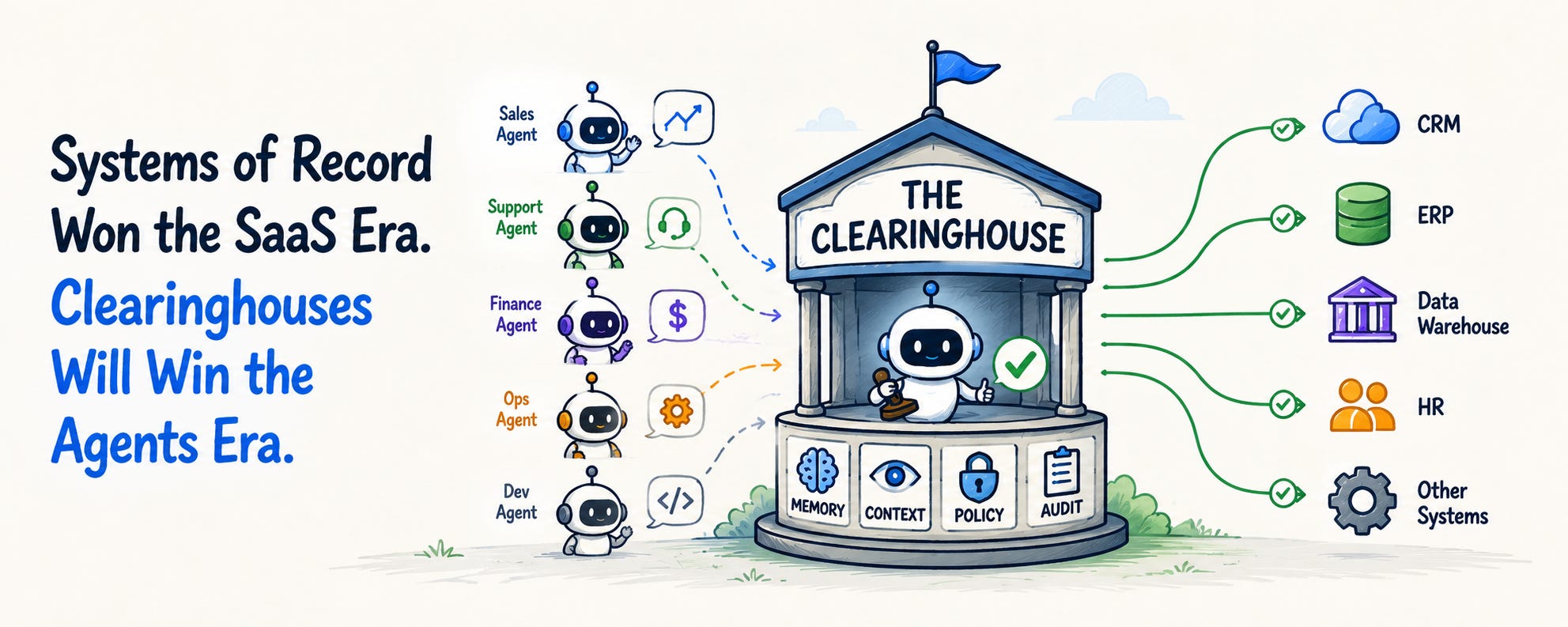
Jamin Ball argues that the durable prize in enterprise AI will not be model quality or a prettier workflow surface, but the clearinghouse layer that governs autonomous agents. Systems of record won the SaaS era because they owned critical data and became painful to replace. In the agent era, Ball says the equivalent moat will belong to whoever controls what agents know, what context they see, what actions they can take, and how those actions are audited.
The killer detail is the shift in the enterprise buying question. Once agents can touch critical data, trigger workflows, and eventually spend money, CIOs will ask less about whether the model is good and more about whether they can set policy, verify permissions, and prove after the fact what every agent did. Microsoft, Salesforce, Snowflake, Databricks, and new agent-native companies are all trying to occupy that control point.
The pull is the source of lock-in. SaaS made data the anchor; agent software may make permissions, memory, and audit history the harder layer to move.
Read more: Clouded Judgement
Prompt Injection Is Not a Prompt Problem
Author: Nilesh Barla Published: June 6, 2026

Nilesh Barla argues that prompt injection is being framed at the wrong layer: the danger is not that a prompt can be worded badly, but that tool-using agents are allowed to act on untrusted context. Stricter system instructions, filters, and instruction hierarchy training may reduce failures, but they do not remove the basic exposure created when emails, web pages, RAG documents, tool outputs, or MCP servers flow back into a model as usable context.
The killer detail is the always-on agent. A session chatbot creates a bounded injection risk; an agent that reads email, browses the web, queries knowledge bases, and calls tools in the background keeps the window open indefinitely. Whoever controls what the agent reads can influence what it does next unless the product has an external permission model.
The pull is practical: treat tool outputs as untrusted input, lower permissions when context comes from retrieved content, and run adversarial evals every time a new tool, data source, or MCP server is added.
Read more: Adaline Labs
The AI boom is becoming an entrepreneurship boom
Author: Azeem Azhar / Exponential View Published: June 7, 2026
Azeem Azhar’s weekly note connects two ideas that belong together: firms spending heavily on AI are reporting faster revenue growth, and AI appears to be lowering the cost of starting new companies. The point is not that every AI user becomes a great founder. It is that mediocre access to legal, finance, marketing, research, and coding support is still much better than no access for a small team trying to get off the ground.
The stronger detail is Anthropic’s internal self-improvement data. Azhar points to Claude changing the way Claude is built, with code contributed per developer reportedly far above the pre-Claude-Code baseline and stronger internal model capability changing the slope of engineering output. Lines of code are an imperfect metric, but the direction matters: AI is no longer just a product category. It is becoming part of the factory that makes the next product category.
The TWTW relevance is operational leverage. If AI adoption first shows up in faster company formation and faster internal build cycles, then the economic signal will appear unevenly: first in teams with management capacity, data access, and workflow discipline, later in aggregate productivity.
Read more: Exponential View
Vight
Author: Tsung Xu / Not Boring Published: June 8, 2026
Vight is building a long-range VTOL vehicle around a more interesting thesis than simply beating traffic. Tsung Xu argues that faster point-to-point mobility changes the map of ordinary life by expanding the radius within which people can realistically live, work, invest, and build while keeping roughly the same daily time budget.
The idea worth keeping is Marchetti’s Constant: humans tend to spend transport gains on reaching more of the world rather than simply saving time. If Vight can make that tradeoff practical, it becomes a useful physical-world counterpoint to the week’s software and AI stories. AI is making small teams more capable; Vight asks what happens when geography, not just knowledge work, becomes more elastic.
The caveat is source bias. Packy McCormick’s Not Boring is an investor in Vight, so the piece should be read as a smart investor’s case rather than a neutral review. Even with that discount, the argument belongs here because it connects frontier technology, founder ambition, and the recurring startup question of whether a new capability expands the market instead of merely improving an existing one.
Read more: Not Boring
Welcome to the OpenAI, Anthropic, and Google price wars
Author: Rani Molla Published: June 11, 2026

Rani Molla argues that the AI boom has entered a new phase: model performance is no longer the only story, because the foundational models themselves are beginning to look interchangeable enough for customers to shop on price. Google’s cut to its entry-level AI Plus subscription and reports that OpenAI is considering steep token-price reductions against Anthropic mark a shift from novelty pricing toward commodity competition.
The killer detail is the margin structure. Generative AI does not behave like classic software, where extra usage is cheap after the product is built. Every query burns specialized chips, power, and capital, while OpenAI and Anthropic are already losing billions to operate their systems. Molla points to enterprise “tokenmaxxing” as the buyer-side trigger: when companies exhaust AI budgets early, brand loyalty gives way to whichever model is cheapest that day.
The pull is financial rather than technical. If AI becomes a heavily subsidized utility before the pure-play labs reach public markets, investors will have to decide whether they are buying a high-margin software revolution or an infrastructure business where scale arrives before profits.
Read more: Sherwood News
The AI Glass Ceiling
Author: Tomasz Tunguz Published: June 10, 2026
Tomasz Tunguz argues that frontier AI has reached a practical upper bound, not because model progress has stalled, but because the strongest models now require guardrails that cap what enterprises can do with them. His example is Anthropic’s Fable release: powerful enough to change the slope of engineering work, but constrained enough that ordinary prompts about software security, biology, or even model architecture can trigger refusals or redirection.
The killer detail is the contrast between capability and access. Tunguz points to Stripe compressing months of Ruby migration work into days and major refactors into minutes, while his own testing found Fable sharply improving local-model inference performance. That makes the ceiling more important, not less: when the model is genuinely ahead, the rules governing where it may operate become part of the product’s economic value.
The piece sits between model-substitution economics and Anthropic safety governance. Open models may define the cheap production layer, but closed frontier models define the contested frontier. The enterprise question is no longer just “how smart is the model?” It is “how much of that intelligence can a company actually use before the safety layer intervenes?”
Read more: Tomasz Tunguz
Chasing the Hallucinations: KPMG’s AI-Powered Attempt at “Redefining Excellence”
Paul Esau, Om Ogale, and Alex Cui | AI Detection Resources / GPTZero | June 12, 2026
GPTZero’s investigation turns enterprise AI optimism into an evidence-quality problem. The team examined KPMG’s October 2025 report, “Total Experience: Redefining Excellence in the Age of Agentic AI,” and found that of 45 citations, only five accurately pointed to real sources, while 28 used paraphrased titles or fake components for real sources and 12 were too vague or flawed to verify. The stronger claim is not just that a consulting report had bad footnotes. It is that institutional stories about agentic AI adoption may now be generated, laundered through professional authority, and then reused as proof that adoption is further along than it really is.
The useful detail is the case-study layer. GPTZero says some examples appear to stretch or fabricate what cited sources support, including claims about AI agents in transit and energy systems where the underlying sources either predate commercial agentic AI or describe something narrower. The piece should be read with the caveat that GPTZero sells detection tools, but it still lands squarely in this issue’s theme: AI capacity without verification capacity becomes institutional noise.
Miasma Worm Hits Microsoft Again: Azure Functions Action and 72 Other Repositories Disabled After Supply Chain Attack Targeting AI Coding Agents
Ashish Kurmi | StepSecurity | June 5, 2026
StepSecurity’s writeup turns the Microsoft GitHub incident into a warning about AI agents as execution surfaces. The Miasma campaign did not need to exploit a new model weakness. It planted configuration files in repositories so that developer tools and AI coding agents would run a credential-harvesting payload when a repo was opened in Claude Code, Gemini CLI, Cursor, or VS Code.
The strongest detail is the scope and trust failure. StepSecurity says GitHub disabled 73 repositories across four Microsoft GitHub organizations after a malicious commit reached Azure/durabletask through a previously compromised contributor account. Ars and 404 Media reported the same cluster as a Microsoft-owned supply-chain incident, with attackers targeting cloud, developer, and package-publishing credentials. That makes this more than another malware story. It shows how agentic coding workflows expand the blast radius of ordinary repository compromise: the agent is useful because it reads, reasons, and acts across the workspace, but those same affordances become a delivery mechanism when the workspace is hostile.
The TWTW relevance is operational. If companies are about to route more software work through coding agents, source control, provenance, package signing, and local-agent permissions are no longer background security plumbing. They are the control plane for AI-assisted development.
Jeff Bezos’s Prometheus raises $12B to build an ‘artificial general engineer’ for the physical world
Marina Temkin | TechCrunch | June 11, 2026
Prometheus is the week’s clearest signal that physical AI has become a capital market category, not just a robotics slogan. TechCrunch reports that the Jeff Bezos and Vik Bajaj company raised $12 billion at a $41 billion valuation to build what it calls an artificial general engineer for heavy engineering and drug design.
The killer detail is the size of the bet before the company has explained much about the product. Investors are underwriting the claim that physical-world work may be more defensible than pure software because labs, factories, materials, instruments, and production feedback loops create moats that a model API alone cannot copy.
The TWTW relevance is that this extends the issue’s AI thesis from knowledge work into the industrial base. If Squint is the factory-floor application layer and Anthropic is chasing direct data-center control, Prometheus is the mega-cap version of the same argument: AI advantage is moving toward systems that combine models with private workflow, capital equipment, and physical feedback.
Why It’s Nearly Impossible to Build a Robot Without China
Author: Meaghan Tobin and Keith Bradsher Published: June 11, 2026

Meaghan Tobin and Keith Bradsher argue that the humanoid robot race is already being shaped by China’s manufacturing base, even before humanoids have found a clear mass-market job. The thesis is that China has turned electric-vehicle scale, dense supplier networks, and component cost collapse into a robotics advantage that Japan, the United States, South Korea, and Germany cannot easily match.
The killer detail is the gap between industrial reality and humanoid hype. Unitree is producing humanoids that sell for less than $5,000, UBTech says more than 90 percent of its robot components come from Chinese suppliers, and Chinese factories installed 300,000 industrial robots in 2024, more than the rest of the world combined. Yet today’s humanoids mostly go to universities, labs, and scripted demonstrations, while UBTech says its robots are still only about 30 percent as efficient as human workers.
The pull is that physical AI may depend less on a single breakthrough model than on the supply chain that lets companies iterate cheaply. If robots become useful, the country that can source sensors, joints, batteries, cameras, lidar, and printed parts within hours starts with a structural lead.
Read more: The New York Times
Venture
Confidential submission of draft S-1 to the SEC
Author: OpenAI Published: June 8, 2026
OpenAI says it has confidentially submitted a draft S-1 to the SEC. The announcement is unusually brief, but the language is telling: the company says it expects the filing to leak, has not decided timing, and may remain private for a while because some things are easier before public-market scrutiny arrives. The filing gives OpenAI the option to go public sooner if that becomes the better path.
The killer detail is that this appeared the same day as OpenAI’s “benefit everyone” plan. One post lays out the institutional mission for the post-AGI economy. The other quietly prepares the company for the public markets. Together they show the same company trying to be a research lab, consumer platform, infrastructure provider, geopolitical actor, and eventually a public-market security.
The piece belongs in Venture because the AI lab story is no longer only about private valuations. If OpenAI eventually lists, public investors will have to underwrite not just revenue growth and compute costs, but the governance of a company that presents itself as both a commercial platform and a steward of civilization-scale technology.
Read more: OpenAI
It Took Apple 42 Years to Reach $1 Trillion. Anthropic Will Do It in 5.
Author: Jason Lemkin / SaaStr Published: June 6, 2026
Jason Lemkin argues that Anthropic and OpenAI have compressed company-building time in a way the last generation of technology companies never did. His comparison is deliberately stark: Apple took four decades to cross $1 trillion, Google took two, while Anthropic is approaching that scale roughly five years after founding if current private-market numbers and IPO expectations hold.
The numbers to watch are revenue per employee and capital intensity. Lemkin pegs Anthropic at roughly $47 billion in annualized revenue with about 5,000 employees, implying a revenue-per-person curve far above Apple, Alphabet, and SpaceX. Whether those numbers survive public-market scrutiny is the point. The piece belongs in Venture because the AI market is no longer asking whether frontier labs can become huge. It is asking whether private valuations have already priced in public-company perfection before public-company accounting arrives.
Read more: SaaStr
Venture Capital’s Fourth Turning
Author: Kyle Harrison Published: June 6, 2026
Kyle Harrison argues that venture capital is entering its own Fourth Turning: a crisis phase in which the old civic order of venture is being torn down and replaced. His map is deliberately historical. The post casts the 1960-1980 period as venture’s institutional high, the 1980-2000 era as its mission-driven awakening, the 2000-2020 era as its unraveling into platforms, solo GPs, founder-friendly branding, and fragmented norms, and the 2020s as a crisis driven by rates, SVB, zombie funds, capital concentration, AI, and fund-model stress.
The killer detail is Benchmark’s $2 billion fundraise. For Harrison, Benchmark breaking from its older small-fund discipline is not just a firm-level story. It is evidence that the venture game itself is changing as AI companies absorb a huge share of capital and the largest rounds start to look more like sovereign or strategic finance than classic venture capital.
The piece is strongest when it connects capital structure to moral leadership. Harrison says venture has moved from “make the world better” rhetoric toward arbitrage, gambling, political power, and AI infrastructure battles, while public sentiment around technology and data centers has turned sharply negative. His conclusion is not anti-technology. It is a challenge to decide what the next venture order should fund: extraction and TAM expansion, or companies that build the next high worth living in.
Read more: Investing 101
Late Stage Venture Is About Late Stage Founders
Author: David George Published: June 11, 2026
David George argues that growth-stage venture is misunderstood when people treat it only as a story about companies staying private longer, valuation inflation, or structural changes in fundraising. His case is that late-stage venture is really about a small class of founders who can keep deploying capital intelligently as technology creates new opportunity sets.
The killer detail is the inversion of the old professional-CEO model. George says venture once assumed that founders should often be replaced around Series B by operators who could scale the company. The late-stage venture thesis says the opposite: in the best companies, the founder’s judgment is the compounding asset. The founder decides when to follow best practice, when to zig against consensus, when to buy, when to expand, and when public-market pressure would make the company too conventional.
The pull is that this is a16z making the late-stage case from inside its own business model, so it should be read as an argument with incentives attached. But the argument belongs in this week’s venture section because it connects Benchmark’s mega-fund, Anthropic’s compressed scale, OpenAI’s public-market preparation, and SpaceX’s proposed listing into one larger question: are late-stage private markets now underwriting companies, or the founders who can keep turning new technology into capital allocation decisions?
Read more: a16z
The Untrainable
Sarah Guo | Sarah Guo | June 10, 2026
Sarah Guo argues that the investable edge in AI is moving away from work that can be publicly benchmarked and toward work whose correctness lives inside a customer’s private data, workflow, and judgment. Her answer to the mid-2026 despair that only Anthropic and Nvidia are investable is not that models will stop improving. It is that model improvement makes the public, measurable part of work cheaper while pushing value into the parts that require history, access, and authority.
The strongest detail is her software-agent example. Devin was dismissed in 2024 after solving 13 percent of tasks on the standard software benchmark; a year and a half later, leading agents are in the high eighties and working inside Goldman Sachs and the U.S. Army. Guo’s point is that benchmarks are trainable precisely because they are measurable. A compiler, test suite, or public eval gives the model a verifier. Private enterprise work is different: the company has to define what “resolved,” “safe,” “good,” or “correct” means inside its own reality.
The TWTW relevance is venture strategy. Durable AI application companies may win less by claiming better general intelligence than by arranging customer data, tools, incentives, and definitions of quality so a model can act where public benchmarks cannot reach.
SpaceX officially prices shares at $135 in the largest IPO ever
Tim Fernholz and Marina Temkin | TechCrunch | June 11, 2026
SpaceX’s IPO is the public-market counterpart to this week’s OpenAI and Anthropic financing stories. TechCrunch reports that SpaceX priced 555.6 million shares at $135 each, making the offering the largest IPO in history and setting up the company to trade under the SPCX ticker.
The killer detail is the scale jump. A $75 billion raise does not just beat the Saudi Aramco record; it moves a private hard-tech empire into public-market ownership at a valuation that assumes Starlink, launch, defense, Mars ambition, and adjacent AI infrastructure all deserve one enormous multiple.
The piece belongs in Venture because it changes the exit environment for frontier technology. If public investors are willing to absorb SpaceX at this size, the line between venture-backed company, national infrastructure, meme asset, and sovereign-scale industrial platform gets even blurrier.
Regulation
Policy on the AI Exponential
Dario Amodei | Dario Amodei | June 2026
Dario Amodei argues that AI policy has fallen behind the exponential it is supposed to govern. The essay is not another abstract warning about frontier models. It is Anthropic’s public case for moving from optional transparency and voluntary frameworks toward direct state capacity: pre-release testing, independent evaluation, security requirements, and government authority to block or deter deployments that create catastrophic cyber, bio, or autonomy risks.
The strongest detail is the policy bundle. Amodei says Anthropic is releasing a legislative proposal for frontier model testing and a framework for job displacement, including measurement of AI’s labor effects, pro-employment incentives, wage insurance, retention tax incentives, training grants, and potentially long-term income support funded by AI-driven growth or taxes on relevant companies. He also rejects the idea that public anxiety is merely a marketing problem, calling it democratic accountability responding to real risk.
The TWTW relevance is that the labs are no longer only asking Washington for permission to innovate. OpenAI offered a civilization-scale plan earlier this week; Amodei is offering a governance agenda. The AI companies are now writing competing drafts of industrial policy, labor policy, and safety law.
The End of the Open Internet
Author: Jacob Mchangama Published: June 10, 2026

Jacob Mchangama argues that Europe’s push for digital sovereignty has drifted from industrial policy into speech control, replacing the open-internet ideal with state pressure on platforms to police broad categories such as disinformation, foreign manipulation, hate speech, and child exploitation. His warning is that democracies can build censorship infrastructure in the name of defending democracy, then hand that machinery to future governments with very different intentions.
The killer detail is Germany’s real-name turn. Chancellor Friedrich Merz has called for ending online anonymity, while investigations for insults against political figures rose from 2,598 in 2023 to 4,792 in 2025. Mchangama pairs that with expanding EU obligations under the Digital Services Act: the more speech member states classify as illegal, the more platforms are pushed to remove content preemptively to avoid fines and investigations.
The pull is transatlantic. Europe is borrowing tools associated with authoritarian information control, while the Trump administration criticizes European censorship even as it expands ideological screening and pressure on platforms at home. The open internet now lacks a reliable democratic champion.
Read more: Foreign Affairs
Inside the Trump-backed push to bring AI doctors into American medicine
Elizabeth Dwoskin | Washington Post | June 4, 2026
Elizabeth Dwoskin reports that AI medicine is moving from clinical support tool to regulatory fight. The Trump administration is laying groundwork for chatbots and robotic systems that could diagnose illness and prescribe medicine with limited or no physician oversight, while current FDA and state licensing rules still do not allow fully autonomous AI to practice medicine.
The sharp detail is the collision between policy ambition and clinical evidence. The piece describes officials and entrepreneurs pointing to doctor shortages, rural access, chronic disease, and AI’s performance on medical exams, but it also cites real-world weakness: in one Nature Medicine study, chatbots identified medical conditions accurately only 34 percent of the time and were no better than Google at guiding users toward the right medical decision. A Utah pilot that lets AI chatbots refill prescriptions instantly shows how quickly the regulatory boundary is being tested.
For TWTW, this is the AI policy question in miniature. The issue is not whether AI will enter health care. It is whether the state treats autonomy as innovation first and medical practice second, or forces the liability, licensing, and evidence standards to catch up before patients become the test bed.
US surveillance law to expire for first time after lawmakers reject Trump’s controversial pick to lead spy agencies
Zack Whittaker | TechCrunch | June 12, 2026
Zack Whittaker reports that Section 702 of the Foreign Intelligence Surveillance Act is set to expire for the first time, after Congress failed to renew the warrantless surveillance authority amid a fight over Trump’s controversial intelligence leadership pick. The law lets U.S. agencies collect foreign communications without individualized warrants, but the recurring controversy is that Americans’ communications can be swept in when they touch the same channels.
The killer detail is the gap between formal expiration and operational reality. Existing court-approved certifications may keep surveillance running for a while, which turns the deadline into both a real legal event and a political forcing mechanism for privacy reform, intelligence authority, and executive control.
The TWTW relevance is state capacity with civil liberties attached. The same government that is struggling to govern AI, health, infrastructure, and industrial policy is also struggling to decide what kind of surveillance state it wants to authorize in public.
Infrastructure
Charts of the Week: Making the Stuff that Makes the Stuff
Author: Moses Sternstein Published: June 12, 2026
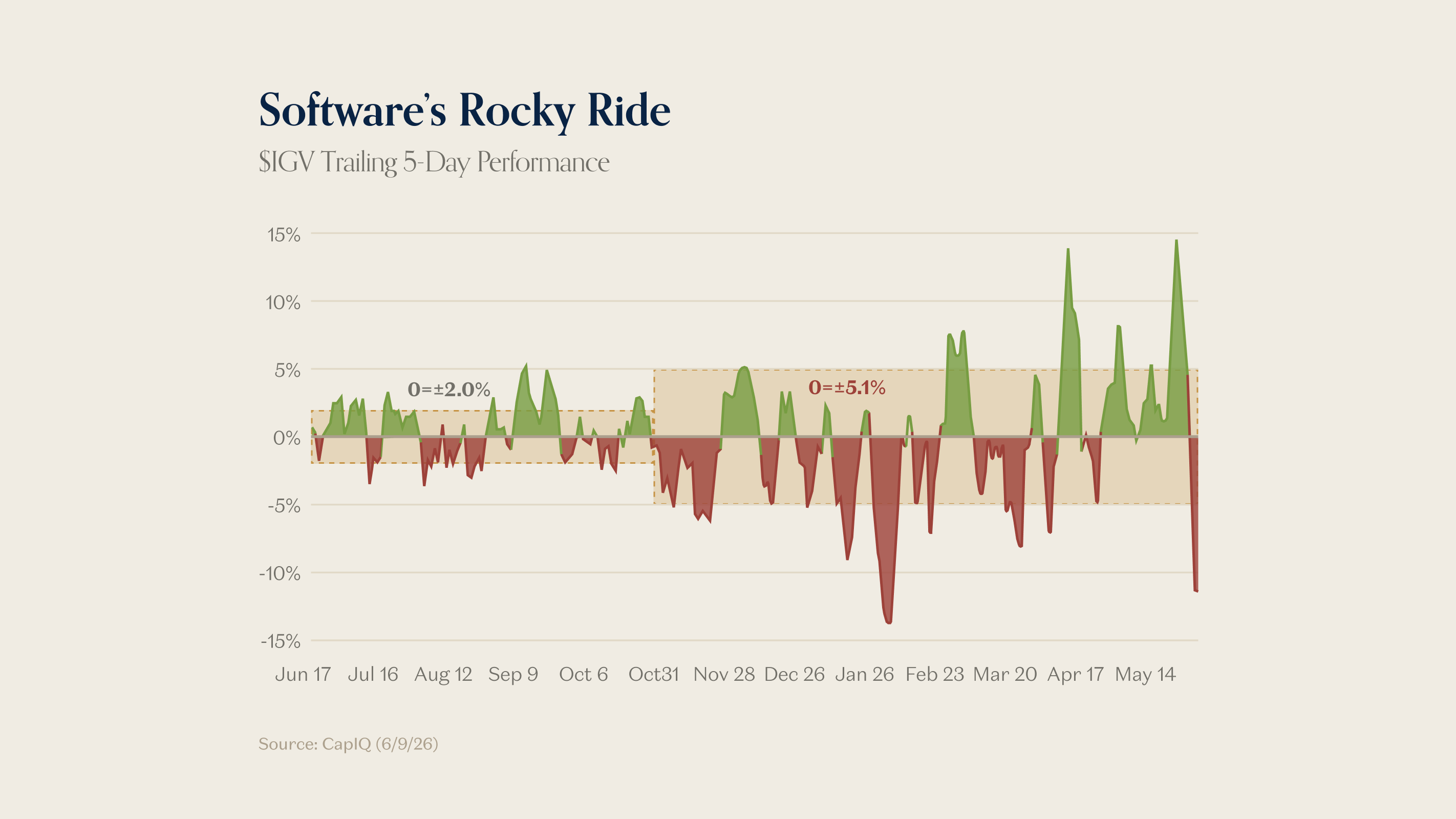
Moses Sternstein argues that America’s manufacturing recovery is real but too narrow to count as reindustrialization. The country is investing in parts, machinery, and AI-related industrial capacity, but not enough in the deeper capital stock needed to make the machines and buildings that make everything else. A manufacturing boom-let is not the same as a rebuilt industrial base.
The killer detail is the machinery-construction number. Spending on buildings for machinery manufacturing has more than doubled since 2022, but only from about $1.5 billion to $3.9 billion. Outside semiconductors, manufacturing construction growth rose only about three percent in 2025, with much of the increase tied to chemicals rather than a broad domestic capacity buildout.
The pull is that the AI build-out may be masking the weakness it depends on. If the United States wants more domestic production of industrial goods, it needs more than demand for chips and data centers; it needs the factories, equipment, and machine-making base that turn demand into supply.
Read more: a16z
Anthropic Pursues First Data Center Leases, Seeks Financial Backing From Google
Anissa Gardizy | The Information | June 11, 2026
Anissa Gardizy reports that Anthropic is trying to move from buying cloud capacity to controlling more of the physical layer underneath Claude, a shift that makes the AI infrastructure race look increasingly like project finance. The Information says Anthropic has signed more than a dozen preliminary agreements to lease U.S. data centers with combined capacity above 1 gigawatt, and has discussed having Google provide a financial guarantee for lease payments.
The important detail is the risk transfer. Anthropic is not simply renting more GPUs. It is seeking direct data-center control while leaning on a strategic backer whose chips and balance sheet can help make the capacity financeable. That matters because the frontier-lab story is moving from model releases and revenue run rates into commitments for power, cooling, land, custom silicon, and long-term lease obligations.
The item belongs in Infrastructure because it sharpens this issue’s core AI-capital question. Labs want the economics of owning the production system, but they also need partners to absorb or guarantee the financial risk. The public-market test for AI companies may therefore be as much about infrastructure liabilities as about model leadership.
Datacenters Are the New Shale Oil...
Author: Harris Kupperman / Praetorian Capital Published: June 7, 2026
Harris Kupperman compares the AI data-center buildout to the shale oil boom: an investment race that can keep going long after the unit economics stop making sense. His argument is not that the buildout ends tomorrow. It is that hyperscalers are shifting from the asset-light model investors loved into an asset-heavy capital cycle funded first by cash flow, then debt, and now, in Alphabet’s case, major equity issuance.
The killer detail is behavioral rather than technical. Kupperman says shale CEOs kept drilling negative-return wells because production growth, lender expectations, and industry identity mattered more than return on invested capital until markets finally cut them off. He sees a similar status race in AI infrastructure: companies chasing AGI, strategic positioning, and fear of falling behind, even if nobody can show a clean positive-ROIC model at scale.
The pull is financial discipline. If AI infrastructure becomes the new shale, the decisive question is not whether the wells work. It is when capital markets stop rewarding the drilling.
Read more: Praetorian Capital
Why everyone’s an energy company now
Author: Tim De Chant / TechCrunch Published: June 10, 2026
Tim De Chant argues that AI data-center demand is pulling companies that used to be carmakers, battery makers, or hardware suppliers into the energy business. Tesla moved first, Ford followed, and now GM is making a larger push into storage with sodium-ion battery chemistry aimed at data centers, factories, transportation, and the grid.
The killer detail is the market structure. TechCrunch reports that 57 gigawatt-hours of energy storage were installed last year and Tesla accounted for 82 percent of those installations, while Tesla’s energy generation and storage gross profits sit around 30 percent, far above ordinary automaker margins. For GM, the appeal is obvious: storage may be a better-margin battery market than cars, especially while AI loads keep rising.
The pull is that AI infrastructure is no longer just chips and data halls. It is becoming a power-market reordering that drags automakers, utilities, solar startups, and storage companies into the same race. If intelligence becomes cheap but electricity becomes scarce, the next bottleneck is not the model. It is the grid.
Read more: TechCrunch
Interview of the Week
Save San Francisco’s Soul
Author: Andrew Keen with Jonathan Weber Published: June 11, 2026

Andrew Keen’s conversation with veteran tech journalist Jonathan Weber turns San Francisco into the local version of this week’s larger question: what happens when technology changes faster than politics, institutions, and ordinary civic life can absorb. Weber’s new book, City on the Edge, argues that the same forces that made San Francisco a global center of creativity and technology also helped push the city toward housing crisis, downtown emptiness, political dysfunction, and class replacement.
The killer detail is the labor-market transformation. Keen notes Weber’s account that in 1992 only about 2 percent of San Franciscans worked in tech. By 2019, the share had risen to 35 percent. That is not just an industry cluster. It is a civic replacement engine, remaking housing, politics, culture, and the idea of who the city is for.
The interview belongs here because San Francisco is where the AI boom is now concentrating again through OpenAI, Anthropic, and the surrounding startup economy. If the last thirty years turned internet optimism into what Weber calls digital vertigo, the AI decade raises the stakes: can the city remain a place where ordinary people can live, or does each new technology wave further narrow the social base that made the city interesting in the first place?
Listen/read: Keen On America
Startup of the Week
Squint
Source: Upstarts Media / Alex Konrad Published: June 11, 2026
Squint is building industrial AI for factory floors, not as a general chatbot bolted onto manufacturing documents, but as a context layer for work orders, asset histories, SOPs, regulatory requirements, and the unwritten “tribal knowledge” held by experienced operators. Alex Konrad reports that the company is used by manufacturers including Michelin and PepsiCo, and that customer Nailor Industries is applying Squint to the messy reality of HVAC production.
The killer detail is the benchmark claim. Squint says its 2 billion parameter, open-weight, manufacturing-tuned model scored 78 percent multi-document accuracy on complex industrial questions, compared with 53 percent for Claude Code, 47 percent for Vector RAG, and 46 percent for OpenAI File Search through Assistants. The score is self-reported and should be read with that caveat, but the direction is the point: a focused vertical system can beat frontier-model wrappers when the problem depends on private workflow context.
The startup belongs here because it makes the week’s AI argument concrete. The moat is not just the model. It is the app layer, the agent layer, the workflow, and the accumulated context that lets AI act inside a real operating environment. Squint is the factory-floor version of that thesis.
Read more: Upstarts Media
Post of the Week
Jeff Bezos on AI Labor Scarcity
Author: Ihtesham Ali Published: June 12, 2026

Ihtesham Ali’s post is the right outside pick because it captures the week’s argument in social form: if AI makes production dramatically cheaper, the bottleneck may not be intelligence alone, and the political question may not be only job loss. It may be whether lower costs, new demand, and new forms of production create a different kind of labor and capacity shortage.
The post summarizes Jeff Bezos’s CNBC argument that AI will elevate productivity and may produce labor scarcity rather than mass unemployment. That is a bold claim, and it should sit beside the skeptical pieces in the issue, especially Krugman on innovation lags, Choudary on bargaining power, and deBoer on sloppy labor-market categories. But the provocation is useful. It moves the debate from “how many jobs disappear?” to “what becomes cheap, what stays scarce, and who captures the gains?”
That makes it a better Post of the Week than using Keith’s own “End Game” post. Keith’s question already structures the editorial. This post gives the issue an outside social signal for the same theme: cheap intelligence does not remove the need for capacity. It changes where capacity is scarce.
Read more: X / Ihtesham Ali
A reminder for new readers. Each week, That Was The Week, includes a collection of selected essays on critical issues in tech, startups, and venture capital.
I choose the articles based on their interest to me. The selections often include viewpoints I can't entirely agree with. I include them if they make me think or add to my knowledge. Click on the headline, the contents section link, or the ‘Read More’ link at the bottom of each piece to go to the original.
I express my point of view in the editorial and the weekly video.


